
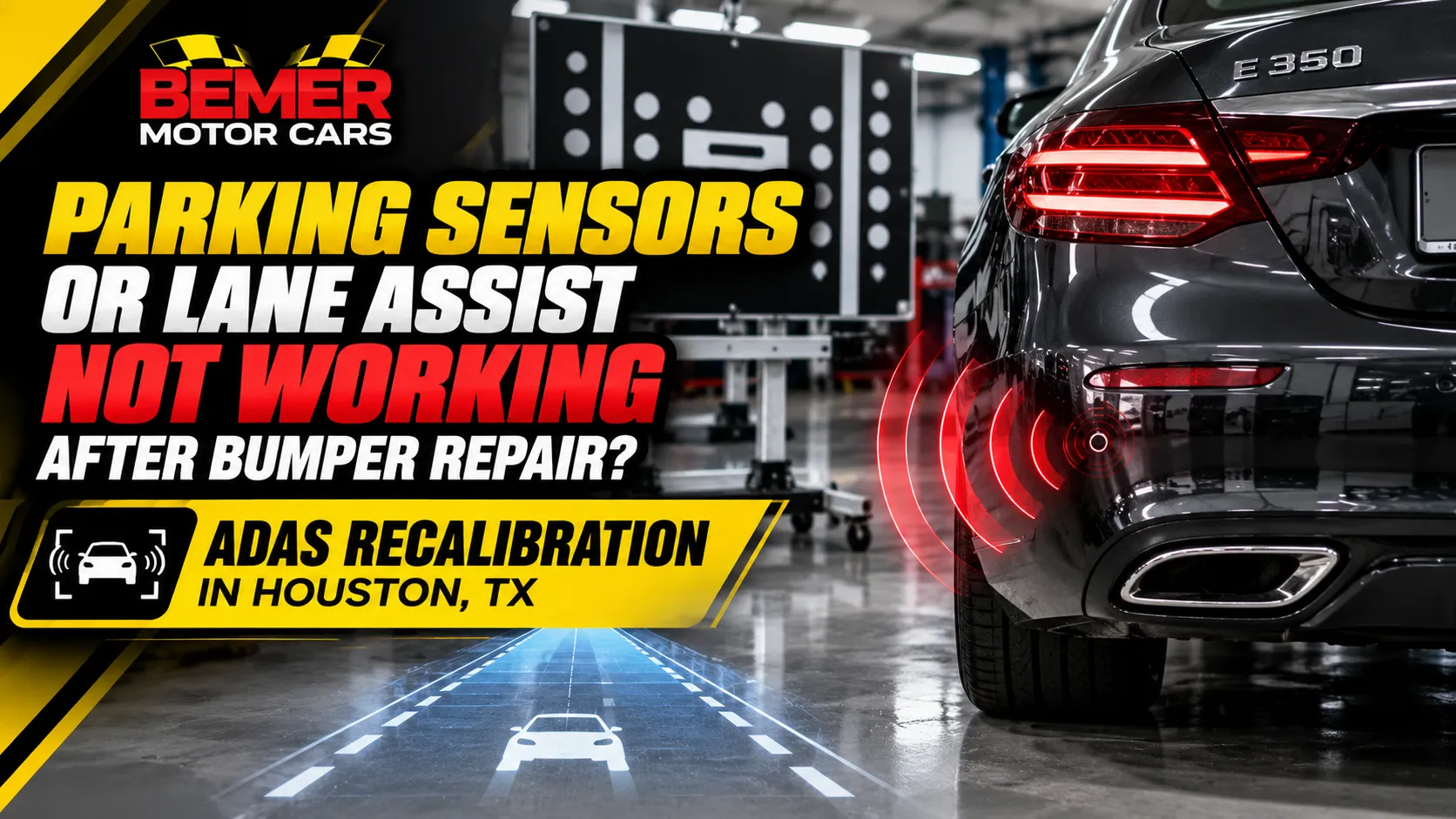
If a warning appears or a driver-assist feature stops working after bumper work, the vehicle may need ADAS recalibration after bumper repair. At Bemer Motor Cars, we can evaluate the bumper and related electronics as part of bumper repair in Houston, TX, for European and luxury vehicles.
Why Driver-Assist Features Can Fail After Bumper Work
Bumper work can affect more than the painted cover. Many vehicles place ultrasonic sensors, corner radar units, wiring, and mounting brackets in or behind the front or rear bumper. Whether ADAS recalibration after bumper repair is needed depends on which components moved and what the manufacturer requires.
Bumper Sensors and Brackets
Parking sensors send and receive signals through openings in the bumper. If a sensor is tilted, pushed too deep, installed in the wrong holder, or covered by excess paint, its detection pattern can change. A bent radar bracket or incorrectly angled bumper cover may also affect blind-spot monitoring, rear cross-traffic alerts, adaptive cruise control, or collision warnings.
These details matter during collision repair in Houston, TX. Houston parking garages, crowded lots near the Galleria, and stop-and-go traffic on the Westpark Tollway can make accurate low-speed warnings especially useful.
Cameras, Radar, Wiring, and Fault Codes
Lane assist often depends on a windshield-mounted camera, not a bumper sensor. Still, lane assist not working after bumper repair can point to a stored fault, interrupted wiring, low battery voltage, alignment changes, or a related radar problem.
Some systems shut down several features when one module reports a fault. For example, a bumper connector left loose may trigger multiple warnings even though the lane camera was never removed. Our BMW collision repair work accounts for the sensors and advanced safety systems that can be affected by even a minor impact.
Signs Your Vehicle Needs a Post-Repair Check
The clearest signs are a dashboard message, a feature that remains unavailable, or warnings that return after every restart. You may also notice parking sensors sounding with no obstacle nearby, failing to detect a wall, or showing one zone as blocked. Uneven blind-spot alerts, a disabled lane icon, or cruise control that will not set also deserves a check.
Clean visible sensors gently and confirm that no tape, wax, dirt, or temporary repair material covers them. If the problem began after body work, return for documentation and testing instead of repeatedly clearing the warning.
How ADAS Diagnosis and Recalibration Work
An accurate repair starts by identifying the vehicle’s installed systems and the work that was performed. ADAS calibration in Houston, TX, should follow the manufacturer’s procedure for that model. Targets, measurements, tire pressures, fuel load, ride height, and road conditions can affect the result.
Pre-Scan and Visual Inspection
A technician first scans the vehicle for diagnostic trouble codes and checks sensor data. The physical inspection covers sensor faces, brackets, bumper fit, wiring, connectors, wheel alignment, and any replaced parts. If hardware is damaged or positioned incorrectly, it must be corrected before calibration can succeed.
A scan alone does not prove that a sensor is aimed correctly. Calibration compares the sensor or camera’s view with a known reference after bumper removal, sensor replacement, structural work, or alignment changes.
Static, Dynamic, and Road Verification
Static calibration uses measured floor space, level conditions, and model-specific targets or reflectors. Dynamic calibration uses a scan tool while the vehicle is driven under specified speed, road, lane-marking, and weather conditions. Some vehicles require one method, while others require both.
Houston glare and heavy rain can prevent a dynamic procedure from completing. That does not mean calibration should be skipped. It means the drive must be performed when the required conditions are available, followed by a post-scan and function check.
Can You Drive With an ADAS Warning After Repair?
You should treat an ADAS warning as a loss of assistance, not proof that the vehicle cannot steer or brake. Keep full control, increase following distance, and do not rely on parking alerts, lane guidance, adaptive cruise control, or automatic braking until the cause is known. Stop driving and arrange help if the warning appears with brake, steering, airbag, or severe electrical faults.
Parking sensors not working after bumper repair may not become obvious until you approach an object. A prompt inspection reduces the chance of depending on an unavailable feature.
Insurance and Repair Documentation
Calibration should be documented when it is part of a collision repair. Useful records include the pre-scan, repair plan, replaced-part details, calibration report, post-scan, and final function check. These records help show why the work was needed and whether the system completed its required procedure.
Texas drivers can review the state’s guidance on the right to choose a repair shop and replacement parts. Coverage still depends on the policy and claim, so ask the shop and adjuster how diagnostic and calibration operations appear on the estimate. Several common misconceptions about collision repairs can obscure why a proper scan matters after a low-speed impact.
Takeaways
ADAS recalibration after bumper repair may be needed when sensors, brackets, wiring, bumper fit, alignment, or system values have changed. Parking sensor errors often point toward bumper-mounted hardware, while a lane-assist warning may require a broader camera, radar, network, and alignment check.
The right process is vehicle-specific. A physical inspection, pre-scan, required calibration, post-scan, and function check give you a clearer answer than simply erasing a warning light.
Frequently Asked Questions
Why are my parking sensors not working after bumper repair?
Your parking sensors may be misaligned, disconnected, damaged, obstructed, or installed in the wrong holders. A technician should inspect the bumper fit and wiring, scan for faults, and test each sensor before deciding whether calibration or a part repair is needed.
Does every bumper repair require ADAS recalibration?
No, not every bumper repair requires ADAS recalibration. The need depends on the vehicle, installed equipment, repair area, parts removed, impact damage, wheel alignment, and manufacturer instructions.
Can a painted bumper interfere with parking sensors or radar?
Yes, paint thickness, filler, metallic content, or an uneven finish can interfere with some sensors or radar units. The repair must follow the vehicle maker’s refinishing limits around sensor zones, and the hardware must remain correctly positioned.
How long does ADAS recalibration take?
ADAS recalibration time varies by vehicle and by whether static, dynamic, or combined procedures are required. Diagnosis or hardware correction can add time, and weather, traffic, or poor lane markings may delay a dynamic calibration drive.
Will insurance cover ADAS recalibration after collision repair?
Insurance may cover ADAS recalibration when it is required by the repair procedure and the loss is covered. Policy terms and claim decisions vary, so confirm the estimate includes the required scans, calibration operation, and supporting documentation.
Schedule ADAS and Bumper Repair Checks in Houston
If a parking, lane, radar, or collision warning appeared after body work, Bemer Motor Cars can inspect the repair area and identify the correct next step. Request collision repair service or call (713) 266-2690 to schedule a check at 9201 Richmond Ave., Houston, TX 77063.